The latest data from NIC points to something we have been watching build for a while: senior housing is moving
back into a position of strength.
And not in a soft, “maybe someday” way.
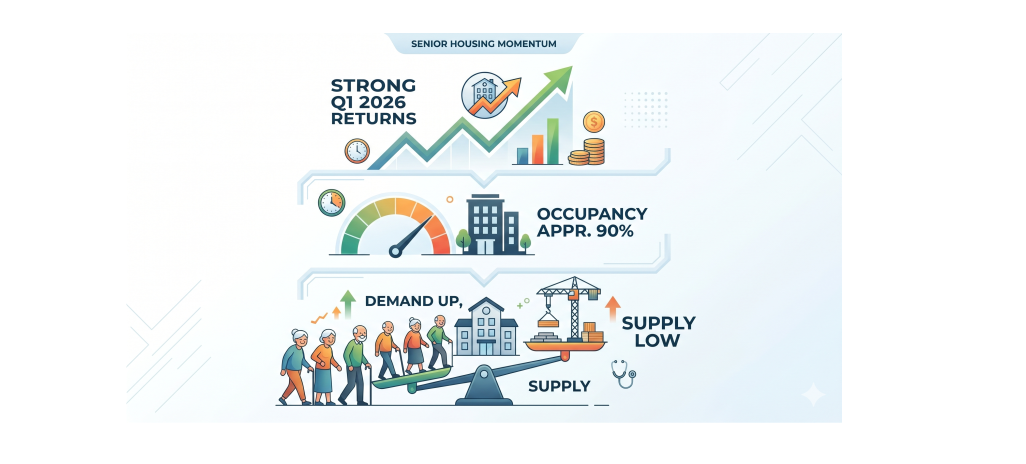
In the first quarter of 2026, senior housing posted a
3.9% total return, its strongest quarterly performance since late 2017. That beat the broader NCREIF Property Index, which returned
1.2% for the quarter. Even better, senior housing has now outperformed the broader property index for
six consecutive quarters.
That matters because real estate investors have spent the last few years looking for something that still has real demand behind it. Office is still trying to find its footing. Multifamily has been hit by supply issues in several markets. Retail has improved, but it is uneven.
Senior housing, on the other hand, is being pushed by one of the most powerful forces in real estate: demographics.
Occupancy Is Nearly Back to 90%
NIC reported that senior housing occupancy in the 31 Primary Markets climbed to
89.5% in Q1 2026. That was a
0.4 percentage point increase from the prior quarter and marked the
19th consecutive quarter of occupancy growth.
That is not a small trend. That is a long recovery turning into a tightening market.
At the current pace, NIC expects senior housing occupancy to surpass
90% before the end of 2026. Secondary markets are already there, reaching
90.2% occupancy in the first quarter.
For investors, this is important. Higher occupancy typically means stronger pricing power, better operating leverage, and improved rent coverage. It also means quality assets may become harder to buy at distressed pricing.
In plain English: the window for buying good senior housing at yesterday’s pricing may be closing.
Demand Is Rising While New Supply Is Stalled
The strongest part of this story is not just rising occupancy. It is rising occupancy paired with very limited new supply.
According to NIC, year-over-year inventory growth hit record lows in the first quarter: only
0.4% for assisted living and
0.3% for independent living in the Primary Markets.
Construction is also way down. Total senior housing units under construction fell to about
16,400 units, a level not seen since 2012. On a percentage basis, units under construction represented only
2.3% of existing inventory, one of the lowest levels in NIC’s time series.
That is the setup investors like to see.
Demand is increasing. Supply is constrained. And because senior housing is difficult to build, license, staff, and operate, new supply is not likely to flood the market overnight.
This is not like throwing up another garden-style apartment complex. Senior housing has more friction. And right now, that friction is helping existing assets.
Investment Performance Is Following the Fundamentals
The improving fundamentals are showing up in investment returns.
NIC reported that senior housing delivered a
12.8% total return over the prior one-year period, the only double-digit return among the NCREIF property type subindexes. That was about
2.5 times the broader NPI return of
4.9%.
Both income and appreciation contributed. Senior housing posted
1.4% income return and
2.5% capital appreciation in Q1 2026, with both metrics reaching their strongest quarterly levels since 2017.
That matters because it suggests investors are not just being paid from income. Asset values are also starting to move.
For a sector that went through a brutal pandemic reset, labor pressure, inflation, and higher interest rates, this is a meaningful turn.
Assisted Living and Independent Living Are Both Participating
One interesting point from NIC’s data is that assisted living and independent living showed comparable investment returns in the first quarter. That is notable because independent living had recently been outperforming assisted living over longer periods.
Occupancy also improved for both property types. Independent living surpassed
91% occupancy for the first time since 2016 in both Primary and Secondary Markets. Assisted living also continued improving, supported by more need-driven demand.
That tells us the recovery is not isolated to one niche. The broader senior housing market is tightening.
What This Means for Investors
The takeaway is simple: senior housing is moving from recovery mode into a stronger operating environment.
For investors, that creates several implications:
First, the easy distressed buys may become harder to find. Operators and sellers can point to stronger market data, improving occupancy, and better forward-looking demand.
Second, underwriting should still be disciplined. A rising tide helps, but it does not fix poor operations, weak staffing, bad local market positioning, or an overleveraged capital stack.
Third, the best opportunities may be in assets that are operationally fixable but located in markets with limited new supply and improving demand. That is where the upside can still be meaningful.
And finally, investors need to understand that senior housing is not a passive “buy it and forget it” asset class. The real estate fundamentals are attractive, but the operator matters. A lot.
The Bottom Line
NIC’s Q1 2026 data confirms what many of us in the sector have been seeing on the ground: senior housing is gaining momentum.
Occupancy is approaching 90%. New supply is historically low. Construction is muted. Investment performance is the strongest it has been in nearly a decade.
That does not mean every deal is a good deal. Far from it.
But it does mean the sector deserves serious attention.
For investors looking for a real estate asset class backed by long-term demographic demand, senior housing is no longer just a future story. It is happening now.