
Senior Housing’s Next Growth Cycle Is Here — Why Investors Are Paying Attention
The senior housing market is shifting from recovery to growth — and investors are starting to move.
Senior housing is moving into one of the most compelling investment windows the industry has seen in years.
After a difficult stretch marked by pandemic disruption, labor pressure, rising interest rates, and delayed occupancy recovery, the sector is beginning to look very different. Occupancy is climbing. New construction remains limited. Pricing power is returning. Capital is flowing back into the market. And transaction activity is running at a record-setting pace.
For investors, that combination matters.
Senior housing is not just another real estate category. It sits at the intersection of demographics, healthcare, housing, and operations. When those forces align, the upside can be significant. And according to the June 2026 issue of The SeniorCare Investor, that alignment is beginning to show up in a very visible way: buyers are active, lenders are engaged, REITs are expanding, and operators are positioning for growth.
The story is not that senior housing is risk-free. No serious investment is. The story is that the sector’s fundamentals are improving at a time when many other real estate categories are still searching for their footing.
That is why investors are paying attention.
A Record-Setting M&A Market Signals Renewed Confidence
One of the clearest signs of investor confidence is transaction activity.
The report notes that the senior care industry is increasingly likely to set another annual record for publicly announced M&A activity. Through the first five months of 2026, the market averaged approximately 81 transactions per month. Annualized, that pace would put the industry just under 1,000 publicly announced transactions for the year.
That would mark the third consecutive annual record.
For comparison, 2025 ended with 877 deals, while 2024 finished with 722. In other words, this is not a one-month spike or a temporary bounce. It is a sustained increase in capital movement across the sector.
That kind of activity usually tells us several things at once. Buyers see upside. Sellers are finding liquidity. Lenders are willing to finance. Operators are looking for scale. And institutional capital is finding the sector attractive enough to compete aggressively for quality assets.
This is especially meaningful given the broader real estate environment. Many property types are still dealing with uncertainty around valuations, refinancing risk, office exposure, consumer behavior, and capital availability. Senior housing, by contrast, is benefiting from a need-based demand story that is much easier to understand.
People age. Care needs increase. Families need solutions. And the industry still has not built enough new supply to fully meet the coming demand.
That is not a trend. That is a demographic engine.
The Operating Fundamentals Are Finally Turning Favorable
The investment case for senior housing starts with operations.
For several years, the sector had strong long-term demographics but messy near-term performance. The baby boomer thesis was always there, but owners still had to survive wage inflation, staffing shortages, census recovery, expense growth, and higher interest rates.
Now the operating picture is improving.
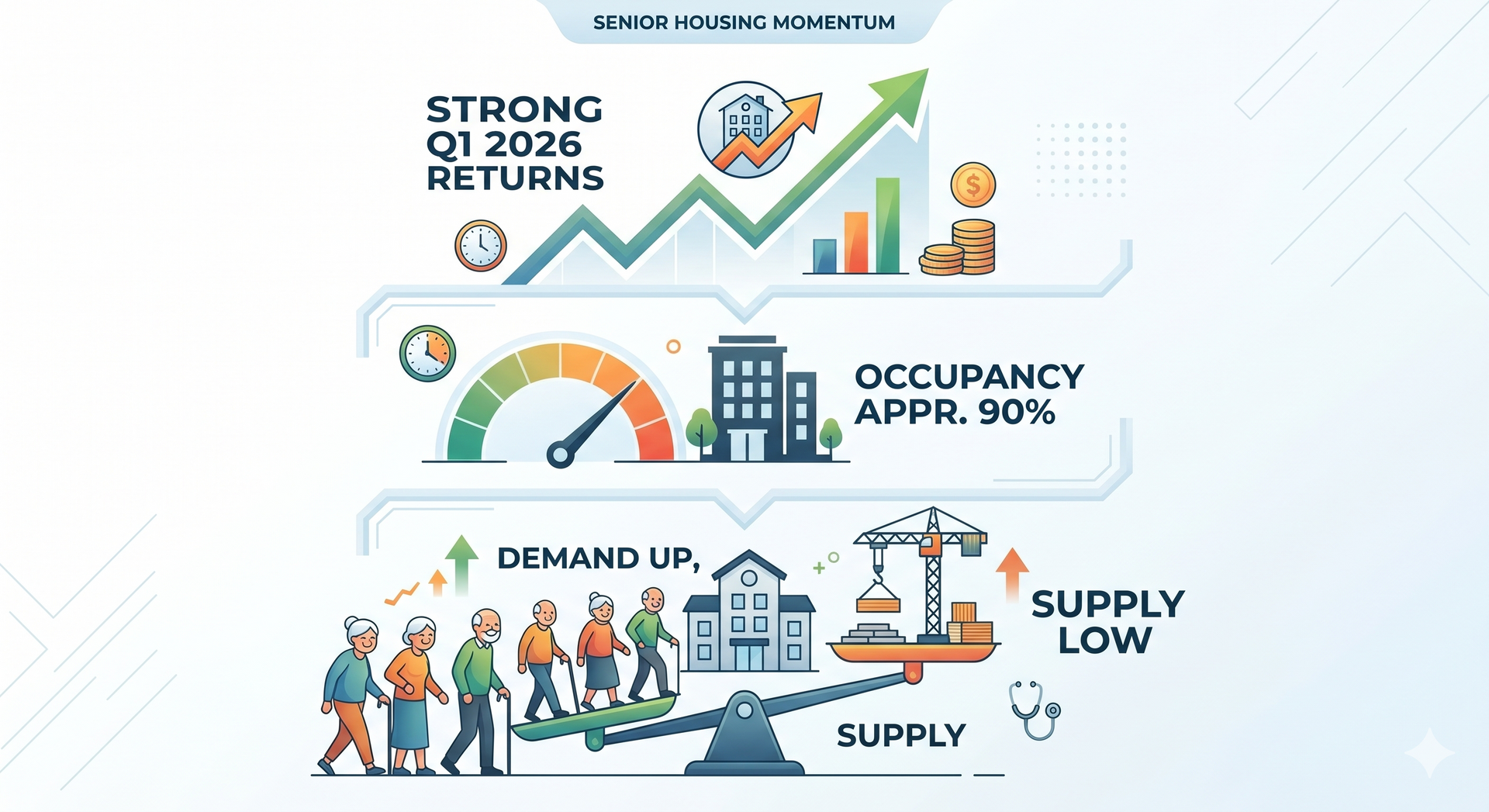
The report points to rising occupancy, limited new competition, stronger pricing power, and the potential for higher margins and cash flow. These are exactly the ingredients investors want to see before entering or expanding in a sector.
The lack of new construction is particularly important. In many markets, the development pipeline has slowed because of high construction costs, expensive debt, and tighter underwriting. That creates an advantage for existing communities. If demand rises while supply stays constrained, well-located assets can benefit from both occupancy growth and rate growth.
That is a powerful combination.
It also gives investors multiple ways to win. A community does not have to be perfect on day one if the fundamentals are good. A buyer may be able to improve occupancy, adjust rates, invest in renovations, reposition the care mix, enhance marketing, or upgrade the operator.
That is why the current market is attractive. There are still assets with upside, but the broader industry backdrop is now more supportive.
Buyers Are Paying for Real Upside
The report highlights a wide range of seniors housing transactions, and one theme keeps showing up: buyers are not just buying current income. They are buying future performance.
That is important.
In a flat or declining market, buyers focus almost entirely on what an asset is producing today. In a growth market, buyers are more willing to pay for a credible path to better performance tomorrow.
Several acquisition examples show this clearly.
Some buyers are taking older communities and repositioning them into more flexible rental models. Others are investing capital into physical plant improvements. Some are expanding memory care or adjusting care mix. Others are keeping strong operators in place to preserve momentum.
The common thread is that capital is looking for assets where the story makes sense.
A good senior housing investment today may include one or more of these value drivers:
- Occupancy recovery
- Rate growth
- Improved labor management
- Operator change or operator upgrade
- Deferred maintenance correction
- Memory care expansion
- Independent living cottage expansion
- Better marketing and sales systems
- Expense control
- Improved care mix
- Stronger local referral relationships
That is encouraging for investors because it means the market is not purely dependent on cap rate compression. There is still operational alpha available.
In plain English: smart buyers can still create value.
Skilled Nursing Remains Active, but Senior Housing Is Getting the Spotlight
Skilled nursing continues to attract capital. The report notes that skilled nursing deals accounted for roughly 40% of publicly announced senior care transactions during the first five months of 2026.
That is a substantial share.
Several skilled nursing deals showed strong buyer interest, competitive bidding, and meaningful pricing. One Florida skilled nursing portfolio sold for $80 million, or approximately $174,000 per bed. The portfolio included 460 functional beds, generated about $46 million in annualized revenue, and was 83% occupied.
The buyer thesis was not simply “buy beds and wait.” It involved improving hospital referral relationships, increasing Medicare census, and optimizing clinical and reimbursement systems.
That is where skilled nursing can be attractive for experienced operators and investors. There are opportunities to improve performance through better systems, better clinical alignment, and more sophisticated management.
But private-pay senior housing is drawing especially strong attention because it offers a cleaner growth story for many investors. Less direct reliance on government reimbursement, rising demand, limited new supply, and improving margins make assisted living, memory care, and independent living especially appealing in the current cycle.
That is why so much institutional capital is shifting toward senior housing operating portfolios.
REITs Are Leaning Into Senior Housing Operating Portfolios
One of the strongest signals in the report is the activity from public REITs.
Several major publicly traded senior care REITs are expanding their exposure to SHOP, or senior housing operating portfolios. This matters because SHOP allows REITs to participate more directly in operational upside.
In a traditional triple-net lease, the REIT collects rent. In a SHOP structure, the owner has more exposure to the performance of the community itself. That means if occupancy, rates, and margins improve, the owner can benefit more directly.
That is exactly the kind of exposure REITs want when they believe the operating cycle is turning positive.
National Healthcare Properties is a good example. The company announced plans to sell an 86-property outpatient medical facility portfolio for $528.2 million, with proceeds likely going toward SHOP acquisitions. Once completed, the company’s portfolio mix is expected to shift meaningfully toward senior housing.
LTC Properties is also expanding its SHOP strategy, including acquisitions and conversions from triple-net structures. National Health Investors has likewise increased its senior housing exposure, including the acquisition of an eight-asset Colorado portfolio with 532 units for approximately $106.9 million.
These are not small moves. These are strategic capital allocation decisions.
The message is clear: major institutional owners believe senior housing has entered a more attractive operating phase.
Welltower’s Growth Shows Just How Much Capital Wants In
No discussion of senior housing investment activity is complete without Welltower.
The report spends significant time analyzing Welltower’s extraordinary growth and its dominant role in the M&A market. According to the report, Welltower has been involved in roughly one-third of all seniors housing and care M&A activity over the past decade based on disclosed prices. Since 2019, its share has been closer to 38%, and in 2025, it reportedly reached 68% of the market.
That is a remarkable level of activity.
For investors, the takeaway is not simply that Welltower is large. The takeaway is that one of the most sophisticated healthcare real estate investors in the country has been aggressively pursuing senior housing exposure.
That does not happen by accident.
Welltower’s activity reflects a belief that the sector offers meaningful growth potential, especially as operating fundamentals improve. It also shows how competitive the market has become for quality assets.
When large institutional players are willing to deploy billions into a sector, smaller investors should not ignore the signal. They should study it.
The opportunity may not be to compete directly with Welltower for trophy assets. The better opportunity may be to identify smaller, local, regional, or value-add investments that institutional capital overlooks or cannot efficiently pursue.
That is often where entrepreneurial investors have an edge.
Consolidation Is Creating Opportunity for Better Operators
Another important theme in the report is operator consolidation.
The Northstar Senior Living and Alta Senior Living merger is one example. LCS and Vi also completed a major merger, creating a combined portfolio of 130 communities across 29 states with more than 45,000 units.
This kind of consolidation reflects a maturing industry.
As senior housing becomes more operationally complex, scale matters. Larger platforms can often invest more effectively in technology, training, recruiting, marketing, compliance, and regional management.
But this does not mean smaller operators are out of the game. In fact, the report includes multiple examples of regional owners, local operators, and even first-time larger-scale buyers acquiring assets.
That is one of the most attractive parts of the sector. Senior housing still rewards local knowledge.
A well-run regional operator can compete effectively by understanding its market, building referral relationships, maintaining staff culture, and delivering a better resident and family experience.
For investors, the operator may be the most important decision in the deal. Real estate matters. Basis matters. Debt matters. But in senior housing, the operator drives the outcome.
A good operator can turn a decent asset into a strong investment. A weak operator can turn a beautiful building into a slow-motion headache.
The Best Investors Will Use Risk as a Filter, Not a Stop Sign
The report does discuss risks, including litigation, regulation, reimbursement pressure, fraud scrutiny, and public relations challenges. Those issues are real, but they should be understood in context.
Every industry has risk. What matters is whether the risk can be understood, priced, managed, and reduced through better execution.
In senior housing, many of the major risks are manageable with the right approach:
- Strong operators
- Clear compliance systems
- Proper staffing practices
- Good documentation
- Thoughtful resident care
- Transparent financial reporting
- Conservative underwriting
- Adequate insurance
- Sensible leverage
- Local market knowledge
In other words, risk does not eliminate the investment opportunity. It separates disciplined investors from careless ones.
That is actually good news.
When a sector requires real expertise, it creates a barrier to entry. Not everyone can do it well. Not every capital source understands the operational details. Not every buyer knows how to evaluate care quality, staffing, licensing, census trends, or local competition.
That gives experienced investors and operators an advantage.
Key Takeaways for Investors
- Senior care M&A is on pace for another record year, showing strong investor demand and market liquidity.
- Senior housing fundamentals are improving as occupancy rises, new supply remains limited, and pricing power returns.
- Public REITs are increasing exposure to senior housing operating portfolios, signaling confidence in the operating upside.
- Buyers are paying for credible value-add opportunities, including occupancy recovery, rate growth, care mix changes, and operator improvements.
- Skilled nursing remains active, but private-pay senior housing is especially attractive because of its demographic demand and lower direct reimbursement exposure.
- Operator quality is becoming one of the most important drivers of investment performance.
- Industry risks exist, but they are manageable with disciplined underwriting, strong operations, and proper oversight.
- Smaller and regional investors may find opportunity in assets too small or too operationally specific for large institutional buyers.
What This Means for Investors Now
Senior housing is entering a new phase.
The last few years tested the industry. Operators had to manage through a pandemic, labor shortages, inflation, rising debt costs, and shifting consumer expectations. Many weaker owners and operators were exposed. But that reset has created opportunity.
Today, the sector has stronger demand, limited new supply, improving occupancy, and renewed capital interest. That is exactly the setup long-term investors look for.
The best opportunities will likely come from disciplined, hands-on investment strategies. Buying at the right basis still matters. Choosing the right operator matters even more. Understanding the local market is critical. So is having enough capital to improve the asset, support the operator, and ride through normal bumps.
But the direction of travel is encouraging.
Senior housing offers something many real estate sectors cannot: a durable, need-driven demand base supported by powerful demographics. The aging population is not a theory. It is already here. And the need for quality housing, care, and support services will continue to grow.
For investors looking for a sector with real estate fundamentals, operating upside, demographic support, and long-term social value, senior housing deserves serious attention.
The opportunity is not in pretending there are no risks. The opportunity is in understanding the risks better than the market, partnering with strong operators, and investing where the demand is real.
Senior housing is not just recovering.
It is repositioning for its next growth cycle.
Recent Posts