
Senior Care M&A Is Accelerating: What Today’s Market Means for Investors
Record deal activity and rising valuations reinforce the long-term opportunity—but disciplined acquisitions and experienced operations will determine who benefits.
Senior Care M&A Is Accelerating: What Today’s Market Means for Investors
The senior care investment market has moved decisively out of its post-pandemic holding pattern. Transaction activity is at record levels, valuations have risen sharply, occupancy continues to recover, and institutional capital is competing aggressively for quality assets.
For investors, that is encouraging—but it is not a license to overpay.
The eighth edition of A Mid-Year Update to The Senior Care Acquisition Report, published by Irving Levin Associates, describes an industry benefiting from favorable demographics, limited new construction, stronger property-level cash flow and improving capital availability. It also makes an equally important point: senior housing remains an operations-intensive business, and favorable demographics do not automatically produce attractive investment returns.
That distinction closely matches the way ABW Senior Investments approaches the sector. The long-term demand story matters, but execution at the individual property level matters more.
Record transaction activity signals growing confidence
Publicly announced senior care mergers and acquisitions increased from 89 transactions in 2009 to 459 in 2019. After the pandemic interrupted the market, dealmaking recovered quickly. The report records 561 transactions in 2022, 518 in 2023, 717 in 2024 and a new high of 876 in 2025.
The report also identifies approximately $31 billion of disclosed transaction volume in 2025. For the 12 months ended June 30, 2026, disclosed volume was $27.3 billion, but that figure excludes several major transactions for which buyers did not release enough detail. The authors therefore caution against reading the reported decline as evidence that capital deployment has slowed.
What does this mean for investors? Capital is no longer waiting on the sidelines. Public REITs, private equity firms, owner-operators, family offices and other real estate investors are all pursuing growth. More lenders are competing for transactions, and larger portfolios and higher-quality communities have returned to the market.
This validates senior care as an increasingly established real estate and operating-business investment category. It also means attractive acquisitions may draw multiple bidders, shortening diligence periods and pushing pricing higher.
Improving fundamentals are translating into higher values
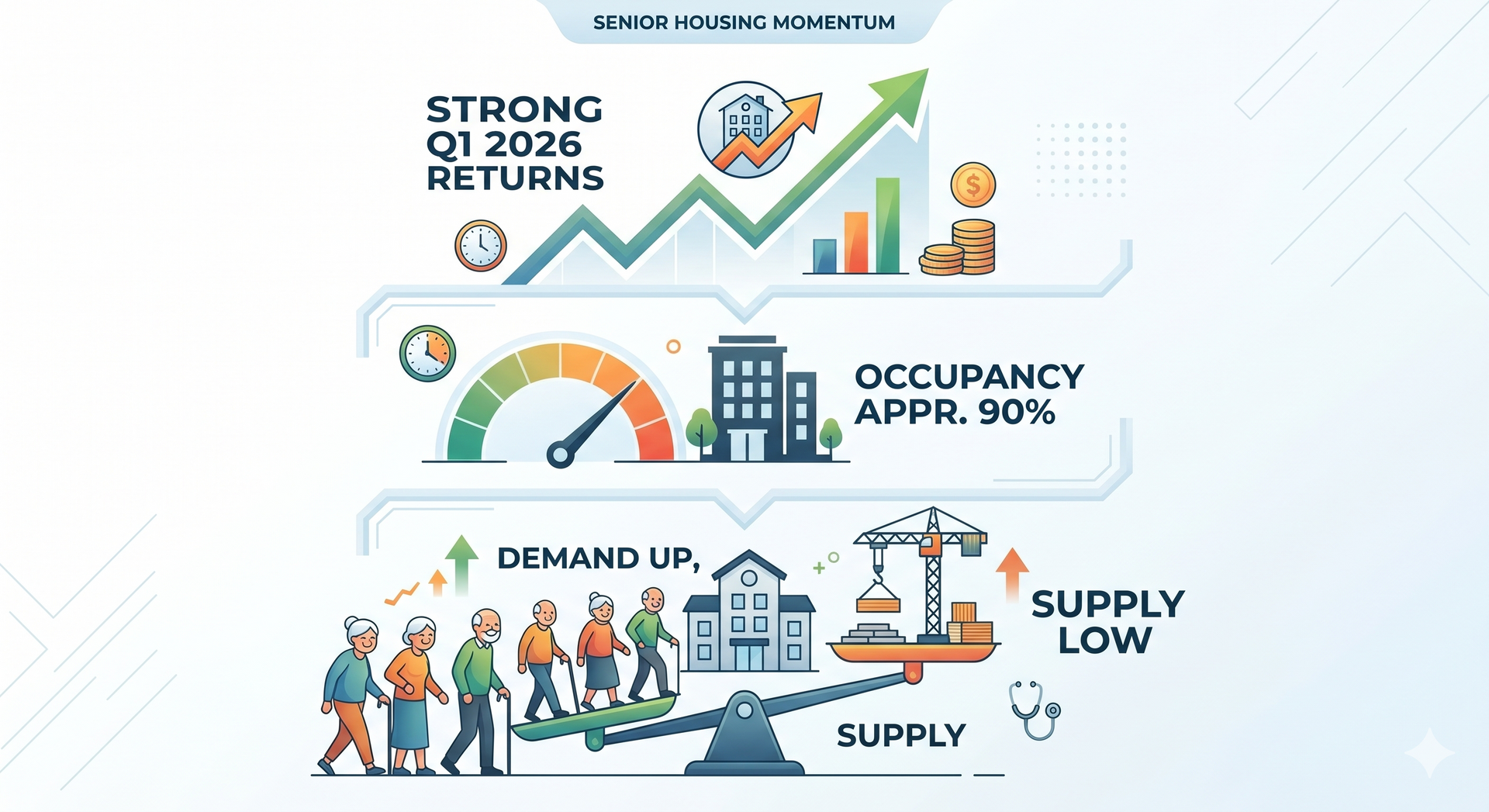
The demand side of the equation is compelling. The oldest baby boomers are now turning 80, while new senior housing construction remains constrained. National occupancy has continued to improve, and stronger occupancy generally supports revenue growth, operating margins and cash flow.
The acquisition market is reflecting those gains.
Across independent living, assisted living and memory care, the report shows the average price falling to $156,300 per unit in 2023 as high borrowing costs and operational disruption kept many stronger properties off the market. By the trailing 12 months ended June 30, 2026, the average had reached a record $332,500 per unit.
Assisted living followed a similar pattern. Its average acquisition price increased from $160,900 per unit in 2024 to $268,600 in 2025, then rose another 21.2% to $325,600 for the trailing 12 months ended June 30, 2026.
Independent living reached an average of $338,100 per unit for the same trailing period, up approximately 28% from 2025. Independent living may benefit first from the aging baby-boomer population because its residents are generally younger and require less care than assisted living residents.
Skilled nursing also reached a new pricing high. The average acquisition price increased from $83,800 per bed in 2024 to $105,600 in 2025 and $124,200 for the trailing 12 months ended June 30, 2026. The report attributes that recovery to improving census, favorable reimbursement in many states, limited bed supply and intense buyer demand.
Not every property participates equally
Headline averages can hide enormous differences between individual properties. Asset condition, location, market depth, staffing, payer mix, operating performance and management quality all affect value.
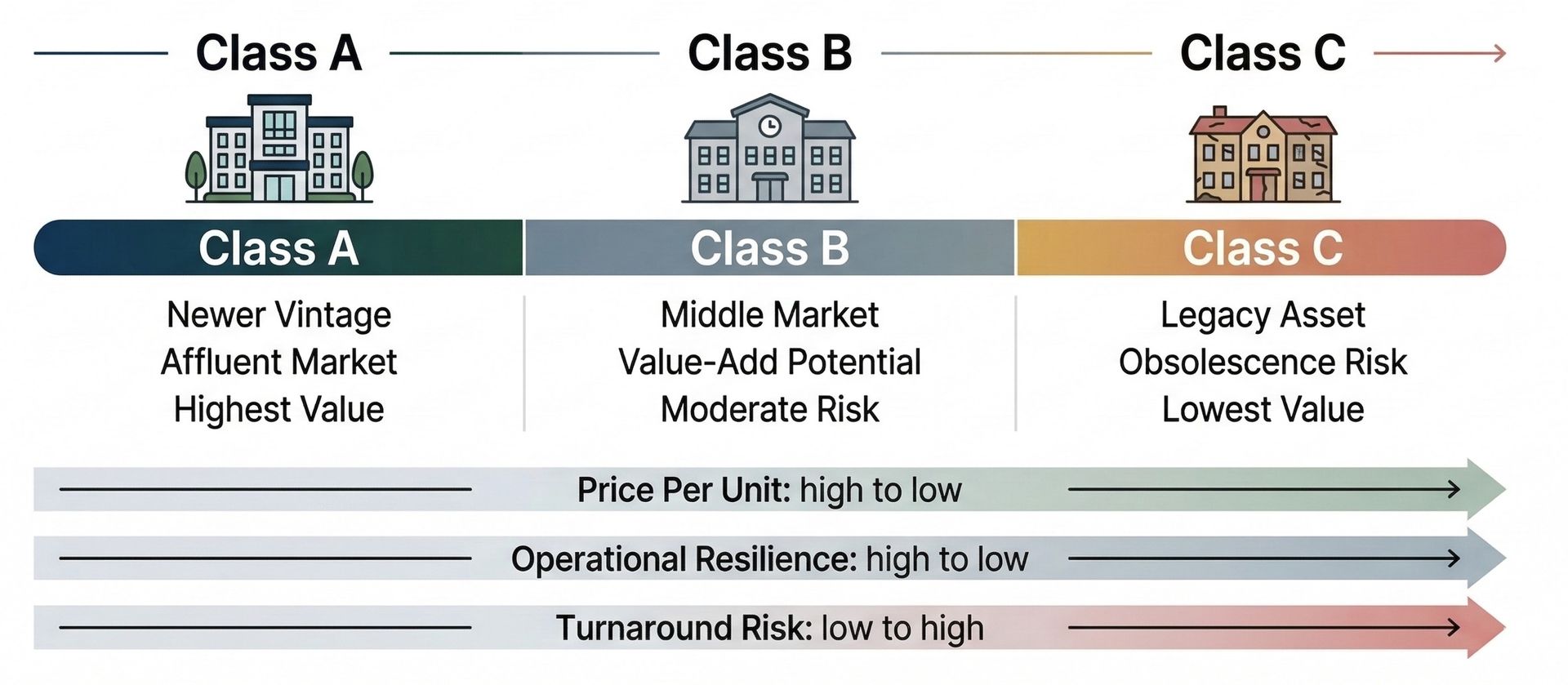
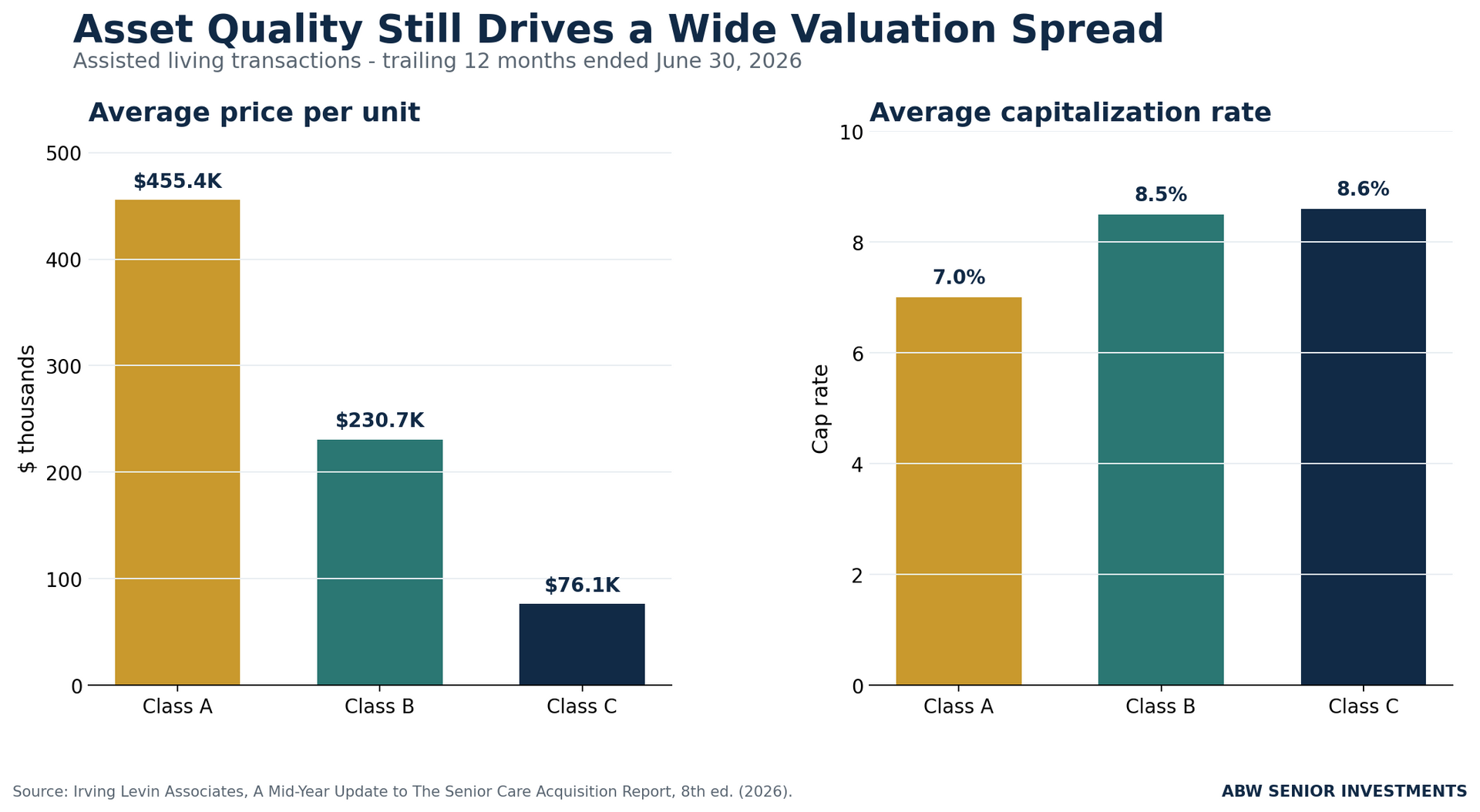
The assisted living data illustrates this divide. For the 12 months ended June 30, 2026, the report shows:
- Class-A communities averaging $455,400 per unit at a 7.0% capitalization rate.
- Class-B communities averaging $230,700 per unit at an 8.5% capitalization rate.
- Class-C communities averaging $76,100 per unit at an 8.6% capitalization rate.
Institutional buyers have focused heavily on newer, high-quality communities, driving some Class-A assisted living transactions above $1 million per unit. However, the report notes that many investors cannot justify those prices and are shifting attention toward Class-B properties.
That is potentially significant for value-oriented investors. A well-located Class-B property acquired at an appropriate basis may offer room for physical improvements, better sales and marketing, stronger operating controls, rent adjustments or a more effective care model. But the phrase “value-add” should never become an excuse for weak underwriting. Renovations cannot fix a poor location, an unworkable labor market or a building that is functionally obsolete.
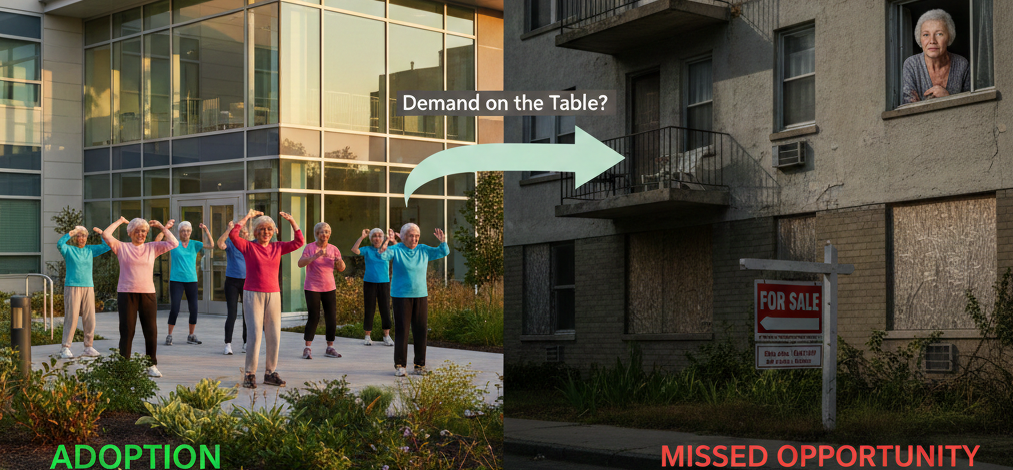
Class-C assets require even more caution. Some may support a credible repositioning strategy, while others may have greater value as alternative-use real estate. A low purchase price is not automatically a bargain.
The opportunity is operational, not merely demographic
The report’s most useful warning is straightforward: favorable demographics do not automatically translate into strong profitability.
Senior care is not passive real estate. Performance depends on management’s ability to maintain occupancy, recruit and retain staff, control overtime and agency labor, manage resident acuity, collect revenue, maintain regulatory compliance and deliver a level of care that earns trust from residents, families and referral sources.
For ABW Senior Investments, the practical implications include:
1. Buy at a basis the operations can support
Rising sector valuations may benefit existing owners, but buyers must still connect purchase price to realistic property-level cash flow. Underwriting should not depend on aggressive rent increases, instant occupancy gains or an exit cap rate that assumes today’s competitive market will remain unchanged.
2. Underwrite the local market—not the national headline
National demographic growth is helpful, but residents choose local communities. Each acquisition should be evaluated using local age and income trends, competitive inventory, construction pipelines, home values, labor availability, referral patterns and the affordability of private-pay rates.
3. Put the operating plan beside the financial model
An attractive spreadsheet is not an operating strategy. Before acquisition, investors should understand who will run the community, what must change, how long stabilization may take, how much working capital is required and which performance indicators will provide early warning if the plan is falling behind.
4. Maintain room for surprises
Staffing expenses, insurance, repairs, regulatory requirements, reimbursement and interest rates can all change. A capital structure should provide enough flexibility to absorb delays and operating volatility without forcing a premature sale or dilutive rescue financing.
5. Align investors, ownership and operations
Senior care investments perform best when the property owner and operator are working toward the same goals. Reporting, incentives and accountability should reward sustainable occupancy, resident care, staff stability and cash flow—not short-term revenue growth at the expense of the community.
Risks investors should keep in view
The market outlook is positive, but several risks deserve continued attention:
- Affordability: The baby-boomer generation is large, but not every household can afford the rates required to support high acquisition and capital costs.
- Interest rates: Elevated Treasury yields and borrowing costs may limit additional cap-rate compression and can materially affect debt-service coverage.
- Staffing: Labor availability and wage pressure remain central operating risks.
- Regulation and reimbursement: Skilled nursing is particularly exposed to changes in Medicaid, Medicare and Medicare Advantage economics.
- Aging in place: Technology and home-based care may allow some older adults to delay moving into senior housing.
- Execution risk: Occupancy gains and rent growth require effective leadership; they do not occur simply because population demographics are favorable.
ABW’s investor takeaway
The report supports a strong long-term case for senior housing and care. Demand is growing, supply growth remains limited, operating performance is improving and sophisticated capital continues to enter the sector.
At the same time, record prices increase the cost of mistakes. The best opportunities may not be the properties attracting the loudest bidding wars. They may be well-located communities where the acquisition basis, local demand and a clearly defined operating plan create a reasonable path to sustainable cash flow and long-term value.
That is the opportunity ABW Senior Investments continues to pursue: senior care investments grounded in property-level diligence, experienced operations, conservative financial assumptions and alignment with our investors.
To learn more about current and upcoming ABW Senior Investments opportunities, contact our team.
Source and important disclosures
Market statistics are from Irving Levin Associates, A Mid-Year Update to The Senior Care Acquisition Report: 2001-2026, Eighth Edition (2026), including data for the trailing 12 months ended June 30, 2026. Graphics were independently recreated by ABW Senior Investments from statistics reported in that publication; they are not reproductions of the publisher’s original charts.
This article is for general informational purposes only and does not constitute an offer to sell or a solicitation to purchase securities. Any investment opportunity offered by ABW Senior Investments will be made only through its applicable offering documents. All investments involve risk, including possible loss of principal. Past market activity, transaction pricing and historical performance do not guarantee future results.
Recent Posts