
The Senior Housing Supply Gap: What Investors Need to Know in 2026
A widening gap between senior housing demand and new supply is reshaping investment opportunities in 2026.
Senior housing demand is no longer a distant forecast
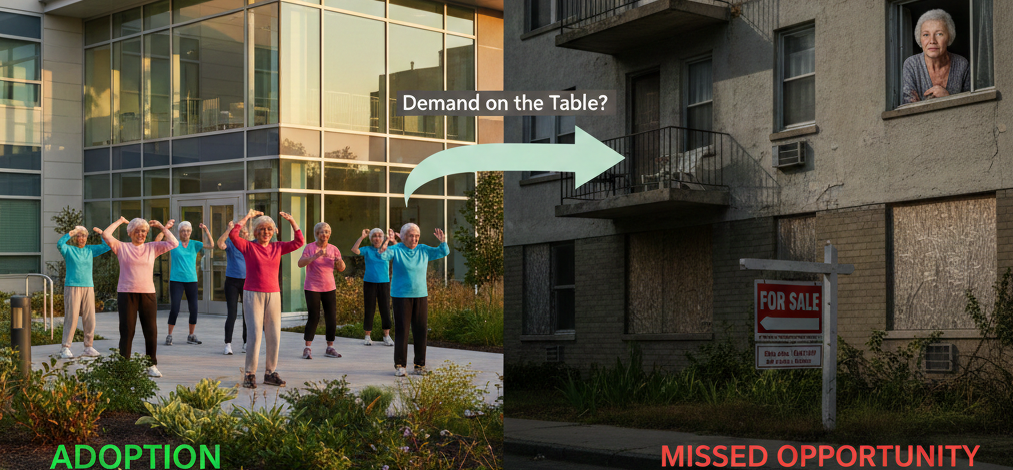
The senior housing investment story has been building for years. In 2026, the demographic wave is no longer something investors can treat as a distant forecast - it has arrived.
The oldest Baby Boomers are turning 80, occupancy is approaching record levels, and senior housing communities are absorbing residents faster than the industry has historically experienced. At the same time, new construction has slowed dramatically.
According to NIC MAP's Senior Housing Market Outlook, Second Edition, these forces are creating a long-term supply-and-demand imbalance - and one of the most significant capital deployment opportunities in commercial real estate. The opportunity is real, but it is not automatic. Investors still need the right market, the right property, and, perhaps most importantly, the right operator.
THE 80-PLUS POPULATION IS ENTERING ITS FASTEST GROWTH PERIOD
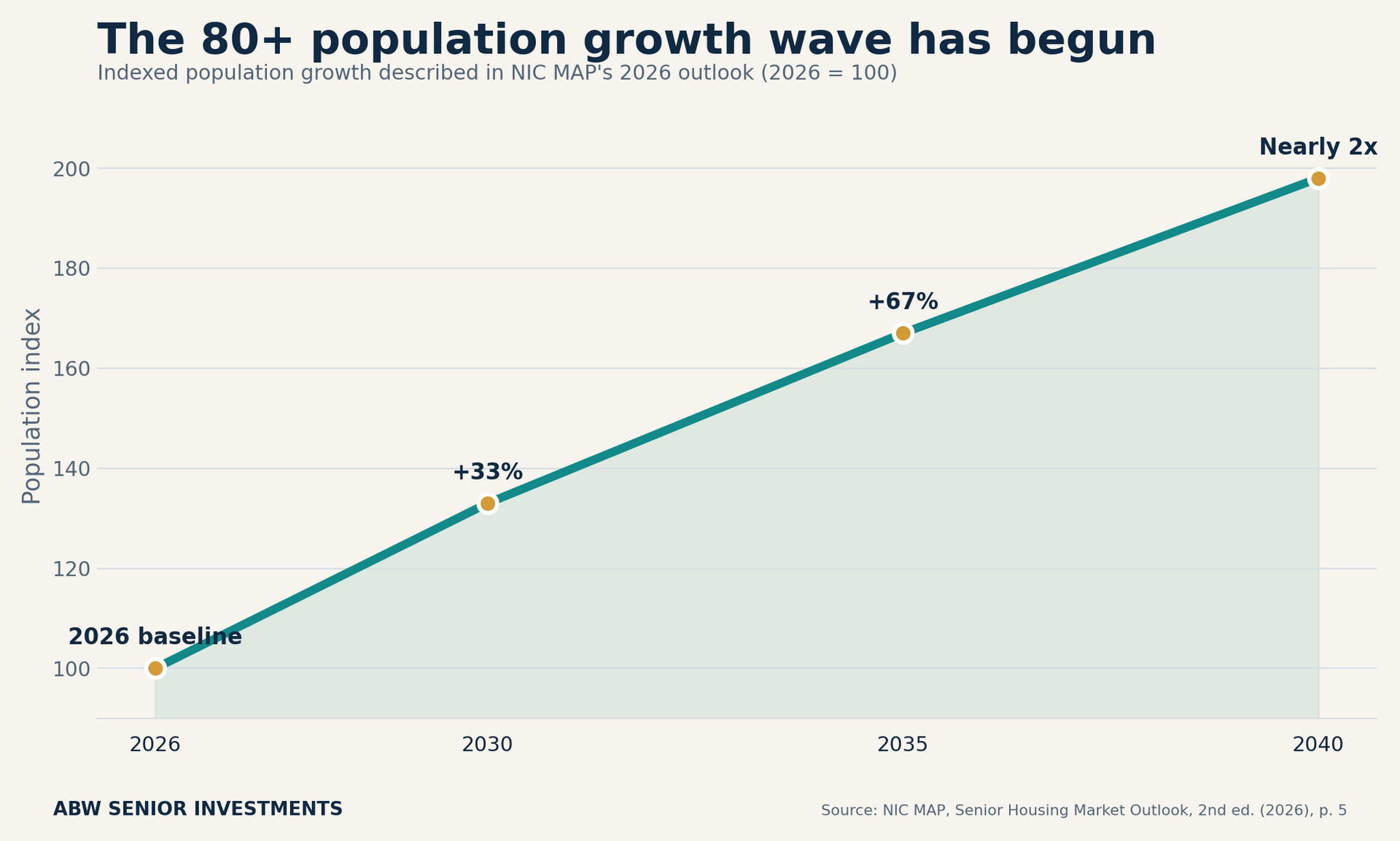
The foundation of senior housing demand is unusually predictable because the future customers already exist. NIC MAP reports that the U.S. population aged 80 and older is projected to:
- Grow by approximately one-third by 2030.
- Increase by roughly two-thirds by 2035.
- Nearly double by 2040.
That represents approximately 5 million additional Americans over age 80 within five years and about 13 million additional people within 15 years. Unlike many economic forecasts, this projection does not depend heavily on interest rates, employment, consumer confidence, or economic growth. It is based primarily on the number of people who are already alive and approaching the age when demand for independent living, assisted living, and memory care typically increases.
For investors, the question is no longer whether demand will grow. The more important questions are where that demand will be concentrated, what type of housing and care it will require, and whether enough appropriate inventory will be available.
OCCUPANCY AND ABSORPTION ARE ALREADY SHOWING THE IMPACT
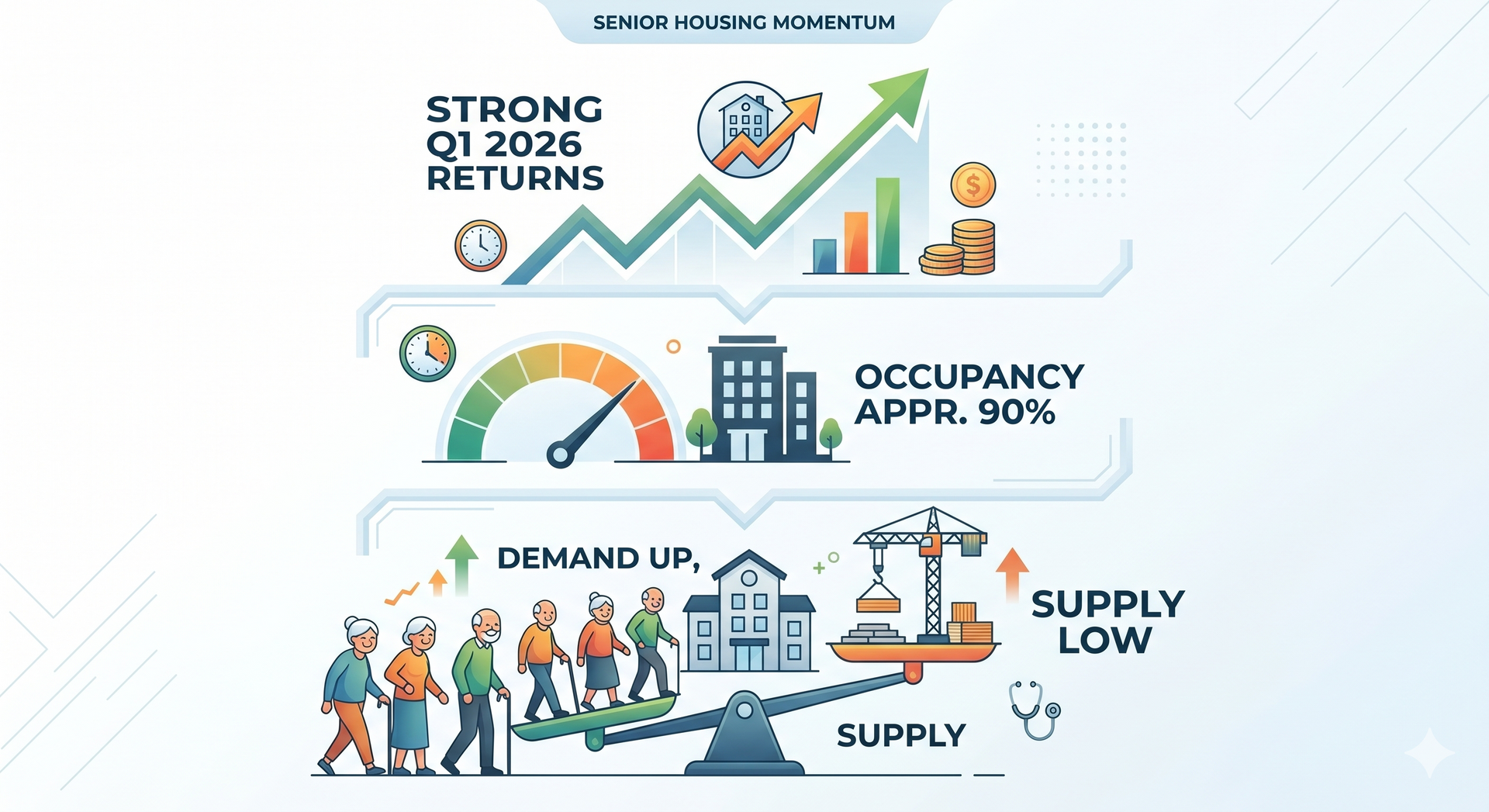
The demographic wave is beginning to appear in actual operating results. NIC MAP reports that stabilized senior housing occupancy has moved above 90%, while median occupancy across primary and secondary markets is approaching 93%. Total occupancy, including properties still going through lease-up, is also projected to exceed 90%.
Demand is also showing up in absorption, which measures the number of units actually occupied. Before 2020, the highest annual absorption recorded across NIC MAP's primary and secondary markets was fewer than 22,000 units. Since 2022, absorption has averaged approximately 32,000 units per year - roughly 50% above the previous record.
One strong quarter can be an anomaly. Four consecutive years of elevated absorption indicate a meaningful structural shift.
CONSTRUCTION IS MOVING IN THE OPPOSITE DIRECTION
Demand is accelerating, but new construction is not keeping pace. Senior housing construction starts in NIC MAP's primary and secondary markets have declined every year since 2021. More than 30,000 units broke ground in 2021, compared with approximately 10,000 in 2025 - a decline of about 67%.
The reasons are familiar: higher interest rates, increased construction costs, skilled-labor shortages, longer entitlement and approval timelines, and operating margins that have not completely recovered to pre-pandemic levels.
A senior housing project generally takes approximately two years to move from construction start to opening. The limited number of projects starting today will therefore affect the availability of new inventory through at least 2027.
This creates a widening gap. NIC MAP projects that the 80-plus population could approach annual growth of 7% later this decade, while senior housing inventory may grow by only about 1%. That gap compounds every year.
THE INDUSTRY MAY NEED MORE THAN 100,000 NEW UNITS ANNUALLY
NIC MAP modeled how many new senior housing units would need to open each year to maintain national occupancy near 90% while holding the current penetration rate steady.
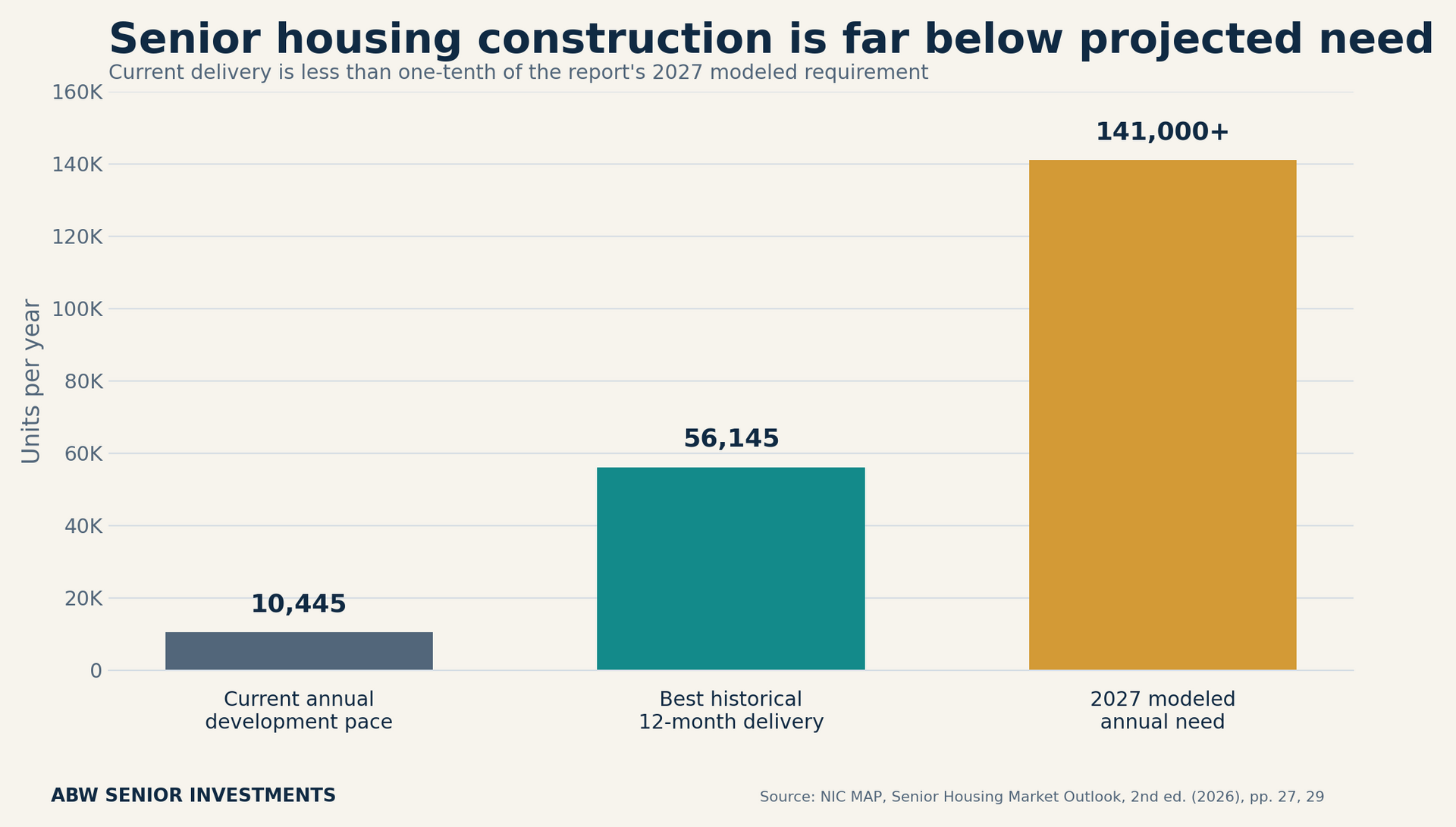
In most years between 2025 and 2035, the industry would need to deliver more than 100,000 units annually. The current development pace is approximately 10,445 units per year. Even the industry's strongest historical year - approximately 56,145 new units - would meet only about half of the projected annual requirement in many coming years.
The projected need rises above 141,000 units in 2027 and remains near or above 100,000 units annually through much of the 2030s. At the current pace, the cumulative shortfall could exceed 1 million units by 2035.
Translated into capital requirements, NIC MAP estimates the long-term investment needed to serve the aging population could exceed $1 trillion by 2050. Solving this challenge will require coordinated investment from developers, lenders, private investors, institutional capital, municipalities, and experienced senior housing operators.
EXISTING PROPERTIES MAY BENEFIT BEFORE NEW CONSTRUCTION CATCHES UP
When demand grows faster than supply, residents must initially be accommodated within the properties already operating. Well-managed communities may experience higher occupancy, improved revenue, greater pricing power, better absorption of fixed operating expenses, increasing net operating income, and stronger valuations or refinancing opportunities.
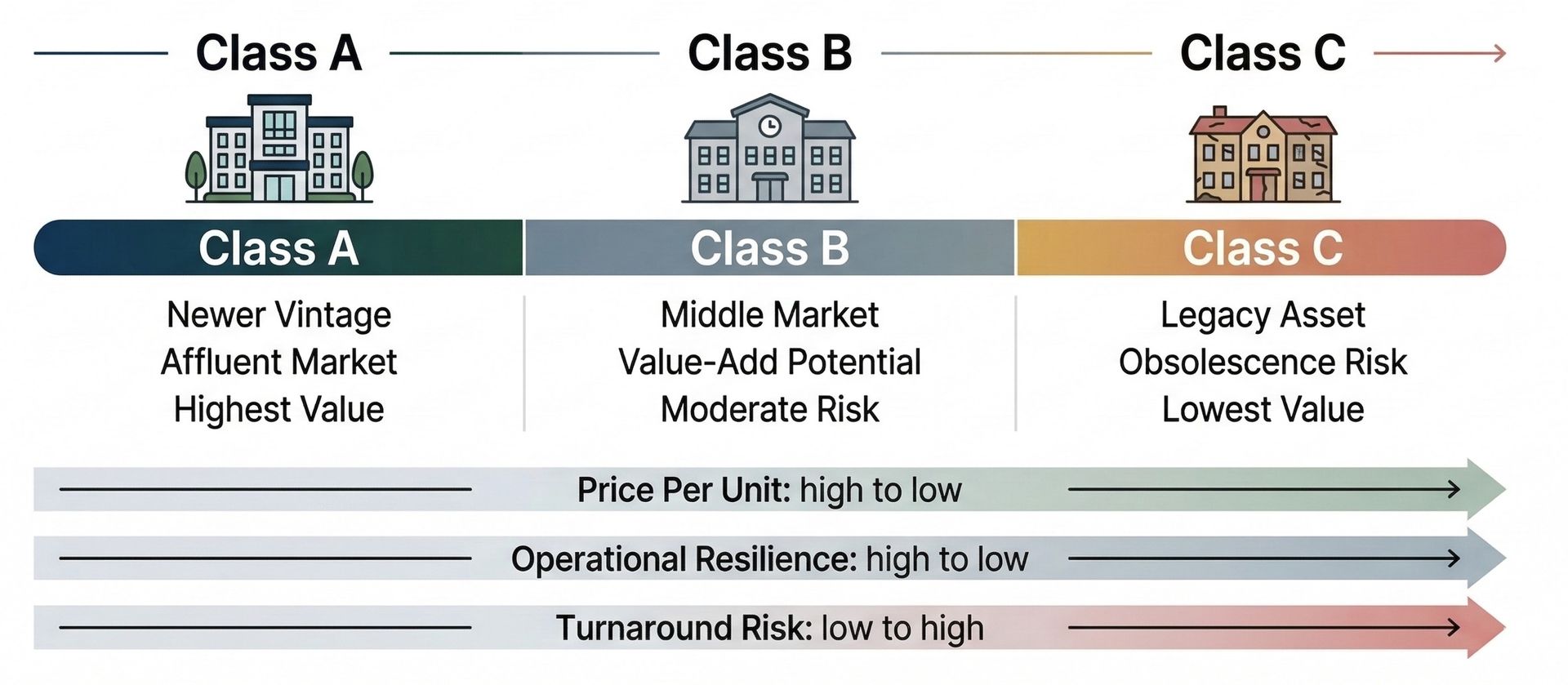
That does not mean every existing community will perform well. More than two out of every five senior housing units are located in properties that are over 25 years old. Older communities may require significant improvements to compete with modern residential expectations, including private bathrooms, improved lighting, updated technology, more efficient layouts, and better common areas.
This creates a repositioning opportunity. A well-located older property may be able to capture growing demand through targeted renovations, stronger marketing, improved resident programming, and better operations. A low acquisition price, however, does not automatically make an older community a good investment. Some properties are undercapitalized, functionally obsolete, located in weak markets, or burdened by operating problems that renovation alone will not solve.
NATIONAL DEMAND DOES NOT ELIMINATE LOCAL MARKET RISK
The national outlook is compelling, but senior housing remains a local business. NIC MAP reports that 28 of the country's 99 largest senior housing markets have median occupancy of at least 95%, and half of those markets have no senior housing currently under construction.
Every opportunity should be evaluated using local information, including:
- Growth in the 75-plus and 80-plus populations.
- Household income, wealth, and home equity.
- Existing competitive inventory.
- New construction and planned developments.
- Private-pay affordability.
- Labor availability and wage pressure.
- Hospital and referral relationships.
- State licensing and regulatory requirements.
- The property's physical condition and functional layout.
CAPITAL IS RETURNING TO SENIOR HOUSING
Senior housing transaction volume exceeded $15 billion in 2025, the highest level recorded by NIC MAP. The number of properties sold also reached a record, showing that the activity was not driven only by a few large portfolio transactions.
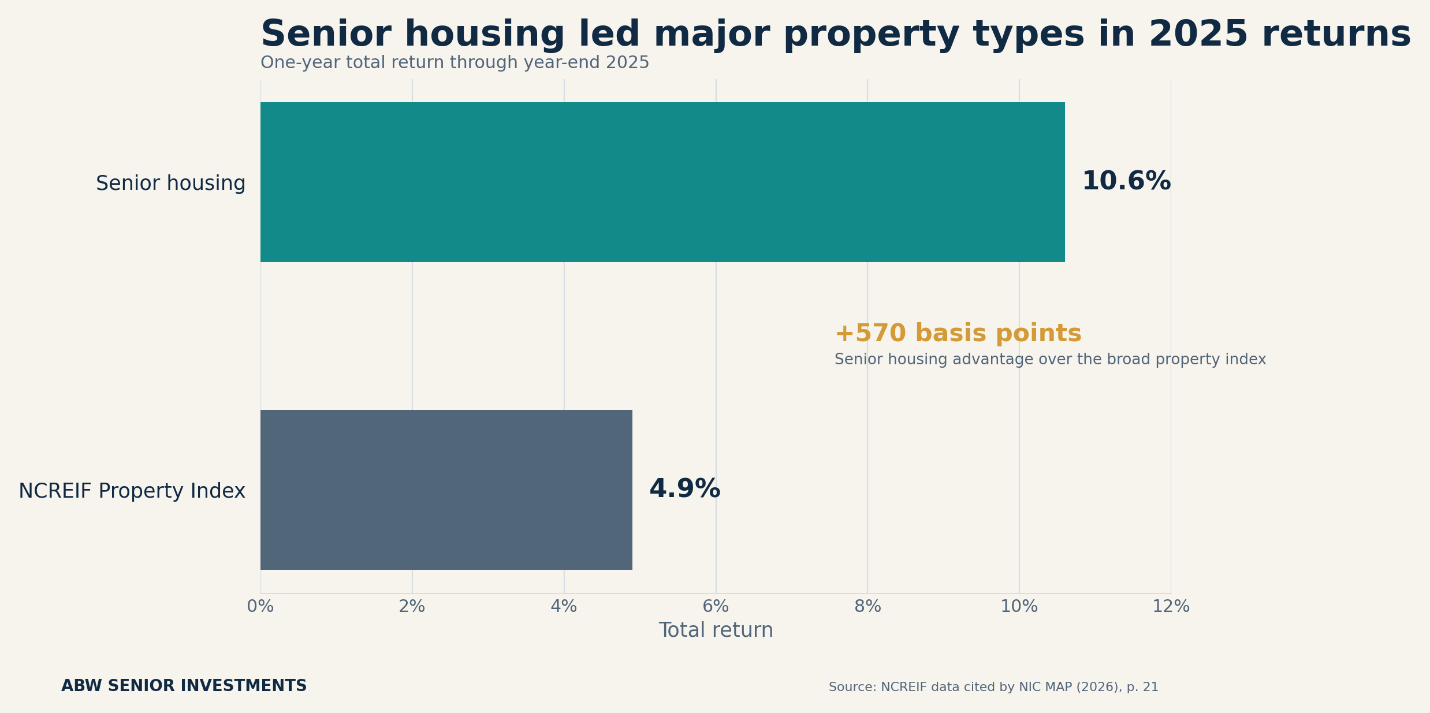
Institutional performance has also been strong. According to the NCREIF Property Index data included in the report, senior housing produced a one-year total return of 10.6% through the end of 2025, compared with 4.9% for the broader property index. Senior housing returns were supported by both operating income and property appreciation.
At the same time, increased capital creates more competition. High-quality communities may attract multiple buyers, and investors can quickly overpay if they assume demographic growth will compensate for an aggressive acquisition basis. It will not.
SENIOR HOUSING IS STILL AN OPERATING BUSINESS
The favorable demographic outlook does not remove the operational complexity of senior housing. Successful performance depends on the operator's ability to:
- Recruit, train, and retain qualified employees.
- Maintain resident occupancy.
- Manage labor and overtime expenses.
- Respond to changes in resident acuity.
- Maintain regulatory compliance.
- Build relationships with families and referral partners.
- Deliver consistent care and protect the property's reputation.
- Convert revenue growth into sustainable cash flow.
A strong market can help a capable operator. It cannot rescue poor management indefinitely.
WHAT THIS MEANS FOR INVESTORS
1. Existing cash-flowing properties may provide the most immediate opportunity. The initial benefits of the supply shortage are likely to flow toward well-located properties that are already operating.
2. Repositioning older communities could unlock value. Good locations and sound physical structures may benefit from renovations, improved management, and stronger resident services.
3. Development will be necessary - but disciplined. Need alone does not make every project financially viable; underwriting must account for land, construction, financing, staffing, affordability, and local competition.
4. Operator selection will remain critical. Poor operations can destroy value even in an undersupplied market.
5. Acquisition discipline matters more as competition increases. Investors should resist underwriting deals based on overly optimistic occupancy gains, rent increases, or exit values.
THE ABW SENIOR INVESTMENTS PERSPECTIVE
The senior housing market appears to be entering a multi-decade period of growing demand, limited supply, and substantial capital requirements. The strongest opportunities will combine demonstrated local demand, a property that fills a specific market need, a basis supported by realistic cash flow, a capable and properly incentivized operator, adequate reserves, and a clear path to sustainable occupancy and long-term value.
The demographic wave is powerful, but demographics are only the starting point. The investments most likely to succeed will be those that combine measurable demand with strong execution.
ABW Senior Investments continues to evaluate senior housing opportunities where the market, property, capital structure, and operating strategy align.
Source: NIC MAP, Senior Housing Market Outlook, Second Edition (2026), particularly pages 5-6, 9, 11-14, 18-21, and 27-31.
Important disclosure: This article is provided for general informational and educational purposes only. It does not constitute an offer to sell or a solicitation to purchase securities or investment products. Any investment opportunity offered by ABW Senior Investments will be made only through the applicable offering documents. All investments involve risk, including the possible loss of principal.
Recent Posts